

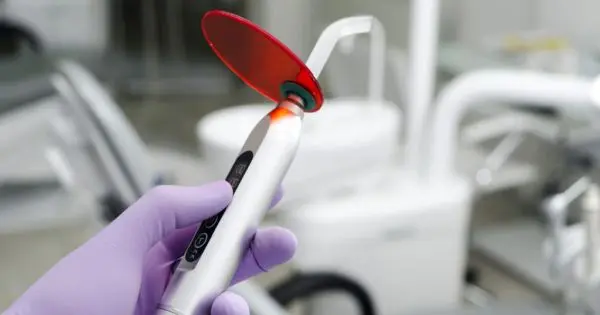
In California, no. The Dental Board of California does not issue a separate laser license or permit for dentists, and laser training is not one of its required renewal courses, so a licensed dentist uses a laser under their dental license. Training still matters: the Academy of Laser Dentistry recommends at least its 12-hour Standard certification before treating patients.
Dentists have used lasers since the FDA first cleared them for dental use in the 1990s, and the technology keeps improving. As it does, more practices add lasers to their offices, and more patients ask a fair question: does the person holding the laser need a special license to use it? In this article, we explain what laser dentistry is, what California actually requires of dentists, hygienists and assistants, and what to ask before your own laser treatment. Read on to find out more!
Laser dentistry
This method of dentistry allows dentists and dental professionals to treat patients in a less invasive way than the traditional surgical approach. There are two broad types of dental lasers: hard tissue lasers and soft tissue lasers. Both are used every day to better treat someone in need. Lasers complement standard tools rather than replace them; most procedures can still be done with a drill or a scalpel, and some cannot be done with a laser at all.
Soft tissue lasers
These lasers, such as diode and CO2 lasers, are mostly used for periodontal treatment and other work on the gums. They can remove or reshape gum tissue and kill bacteria, and they are not as harsh on the surrounding tissue as a blade. When someone has gum disease, infected tissue can be treated with a soft tissue laser, often with less bleeding and swelling afterward. Soft tissue lasers are also used to treat cold and canker sores.
Hard tissue lasers
Laser dentistry that uses hard tissue lasers, such as erbium lasers, is aimed at the teeth and bone. Their light is absorbed by water and by the mineral in teeth, which lets them remove decay and prepare a tooth for a filling, often with less vibration and noise than a drill. Our WaterLase iPlus is this kind of laser: it combines laser energy with a fine spray of water.
Does a Dentist Need Special Licensing to Use a Laser in California?
Not a separate state license. The permits the Dental Board of California issues to dentists cover things like additional offices, mobile clinics, oral and maxillofacial surgery, elective facial cosmetic surgery and oral conscious sedation; there is no laser permit on the list. The board's mandatory continuing education for renewal is also a short, fixed list (infection control, the Dental Practice Act, basic life support and opioid prescribing), and laser training is not on it. A dentist who uses a laser does so under the same dental license that covers the rest of their work.
That does not mean training is optional in practice. Every dentist undergoes the same core training in which they learn to diagnose and treat the teeth and gums, and some go on to specialize further, in fields such as periodontics or oral surgery. Lasers can be used in almost every field of dentistry, and each laser has its own wavelength, settings and safety rules. The Academy of Laser Dentistry says it is always the clinician's license and responsibility to determine whether they are permitted to use a laser within their state's scope of practice, and it recommends that anyone using a laser complete, at minimum, its Standard certification, a course of at least 12 hours that includes hands-on training. Dentists who are trained on their own laser are the ones best placed to offer less invasive procedures to patients in need.
Who regulates the rules for lasers used in dentistry?
Two different bodies regulate two different things. The FDA regulates the laser itself: medical lasers are medical devices, they must meet federal laser safety performance standards (21 CFR 1040.10 and 1040.11), and each model is cleared only for the specific uses listed in its clearance. One dental diode laser, for example, is cleared for cutting, removing and coagulating oral soft tissue, tooth whitening and temporary pain relief. The FDA clears dental lasers for listed indications rather than approving them for any use. The state's dental and dental hygiene boards decide who may use a laser, for which procedures and under what supervision. In the treatment room, federal workplace safety guidance points to the ANSI Z136.3 standard for lasers in health care and to a laser safety officer who oversees laser hazards.
Can a dental hygienist use a laser in California?
Yes, within limits. California law lets a registered dental hygienist use any material or device approved for a procedure within their scope of practice, at the required level of supervision, if they have the appropriate education and training (Business and Professions Code section 1914). Soft-tissue curettage is one such procedure: a hygienist may perform it only under the direct supervision of a dentist who is physically present, after completing a course approved by the Dental Hygiene Board of California (section 1909), and that course may include training on a laser approved for soft-tissue curettage (California Code of Regulations, Title 16, section 1107). Hygiene practice does not include surgery or cutting of hard or soft tissue (section 1908).
Can a dental assistant use a laser?
Not for cutting tissue. California law says the duties of a dental assistant, including one with an orthodontic or sedation permit, do not include surgery or cutting on hard or soft tissue (section 1750.1). Even the bleaching duty of a registered dental assistant is limited to activating whitening agents with a nonlaser light-curing device (section 1752.4). We found no California rule that names lasers for assistants beyond these limits, so the practical answer is that laser treatment in a California office is done by the dentist, or by a trained hygienist within the limits above.
| Role | Laser use allowed | Training and supervision | Where the rule is |
|---|---|---|---|
| Dentist (DDS or DMD) | Within the scope of the dental license | No separate laser permit or required laser CE; ALD recommends at least 12 hours of Standard certification | Dental Board permit and CE lists |
| Registered dental hygienist | Devices approved for procedures within hygiene scope, such as soft-tissue curettage; no cutting | Appropriate training; curettage needs a board-approved course and a dentist present | B&P Code 1914, 1909, 1908; 16 CCR 1107 |
| Registered dental assistant | No cutting of tissue; tooth whitening activation only with a nonlaser light | Not applicable | B&P Code 1750.1, 1752.4 |
| Dental assistant | No surgery or cutting of hard or soft tissue | Not applicable | B&P Code 1750.1 |
Laser Training and Certification
Because California does not license laser use separately, the training a dentist has is a professional choice, and it is worth asking about. The best-known credential comes from the Academy of Laser Dentistry, a private professional academy. Its Standard Level certification is described as the minimum education level for any dental professional to use lasers on patients safely, and it leads on to fellowship and mastership programs. It is a professional credential, not a state license.
How much is a laser license?
For a California dentist there is no state laser license to buy, so there is no state fee. Laser courses and certifications are offered by private organizations, which set their own prices. Some advertisements say a course lets you meet the requirements for dental laser licensure; that may be true in states with their own rules, but California has no such dentist license.
How to Check Your Dentist Before Laser Treatment
A few questions give you a clear picture before any laser procedure:
- Is the dentist licensed and in good standing? Look them up by name on the California Department of Consumer Affairs license search (search.dca.ca.gov).
- Which laser will be used, and is this procedure one of its cleared uses?
- What training has the dentist had on this particular laser?
- Will everyone in the room, including you, wear protective eyewear?
- Is a laser the best tool for this job, or would a conventional approach work better?
- If a hygienist will use the laser, is the procedure within hygiene scope and will a dentist be present?
Is Laser Dentistry Safe?
In trained hands, the risks are low. Cleveland Clinic describes the risks as minimal, with one caution worth knowing: any tool that uses heat can harm healthy tissue if it is used incorrectly. That is exactly why settings, technique and training matter. The other main safety point is your eyes. Laser light can injure the eyes, so the patient and everyone in the room wears protective eyewear during treatment, and you should never look toward the laser tip.
Laser Dentistry at Infinite Dental Wellness
Dr. Leon Kiraj and Dr. Liana Muradyan use laser technology across a number of treatments at our Glendale office. The WaterLase iPlus lets us treat many cavities with little or no drilling, and most of our patients no longer need anesthesia for that kind of treatment. We also use lasers for gum care, gum contouring, laser teeth whitening, and cold and canker sore treatment. Not every procedure suits a laser, and we will tell you when a conventional approach is the better choice. Dr. Kiraj holds California dental license 56744, which you can verify on the state license search. Our article on whether laser dentistry is right for you covers the patient side in more depth.
Contact us today
Are you curious about laser dentistry and what it can do for you? If you have questions or concerns about this method of dental care or any other procedures, then please reach out to our office today so we can further help you. Give us a call or stop by to get started. Request an appointment online or call Infinite Dental Wellness at (818) 541-1110 for an appointment in our Glendale office.
Check out what others are saying about our services on our patient reviews page.
Get Your Confident Smile: Book Today
Ready when you are. Our team at Infinite Dental Wellness makes scheduling a breeze and welcomes new patients for cleanings, cosmetic care, or dental emergencies.
Sources
- Dental Board of California: Permits (dentists)
- Dental Board of California: Continuing education requirements for dentists
- Dental Hygiene Board of California: 2025 Laws and Regulations (B&P Code 1902, 1908, 1909, 1914; 16 CCR 1107)
- California Business and Professions Code section 1750.1 (dental assistant duties)
- California Business and Professions Code section 1752.4 (registered dental assistant duties)
- FDA: Medical Lasers
- FDA 510(k) K162114: dental diode laser indications (example clearance)
- OSHA Technical Manual, Section III, Chapter 6: Laser Hazards
- Academy of Laser Dentistry: Dental Regulations
- Academy of Laser Dentistry: Training and certification courses
- Cleveland Clinic: Laser Dentistry
- California Department of Consumer Affairs: License search