
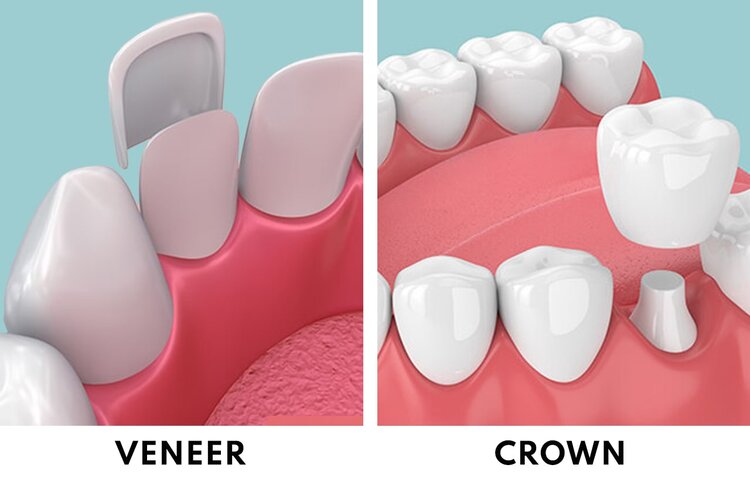
Veneers and Crowns
Veneers and crowns are both dental restoration methods that can improve the look and function of your teeth. The main difference is that a veneer can cover only the front of your tooth and a crown can cover the entire tooth. Veneers tend to come in one of three variations: porcelain, no-prep, or composite (chairside.) Porcelain offers the best durability and aesthetic results, making them the standard for most smile makeovers.Dental veneers are made of wafer-thin porcelain and other materials (about 1 millimeter thickness) that is bonded to the front of a tooth.
The porcelain is color-matched to your natural teeth. Veneers are strong but brittle, and sharp or repeated impacts can dislodge or crack them.A crown, also known as tooth caps, are full-coverage restorations that act like a tiny little helmet that goes over your tooth. The protective shell covers the entire tooth surface all the way up to the gumline, completely sealing it underneath. It can be made of metal, porcelain or a combination of both. It is usually around 2 millimeters of thickness, making it more durable and resistant to cracking than a veneer.
Difference in Procedure
Deciding between veneers vs. crowns is actually a fairly straightforward process for most people.Veneers are a more conservative treatment than crowns. Less of the tooth needs to be removed in order to place a veneer. Your dentist will usually just remove a thin layer of tooth enamel from the front of the tooth and will not need to touch the core or the back of your tooth. Veneers are also being used to correct alignment, teeth being prepared for veneers may be accompanied with the more aggressive trimming characteristic of crowns.Crowns require between 60% and 75% of the existing visible tooth to be trimmed away before the crown is placed. This typically means two to four times as much tooth reduction as veneers.
When Are Veneers The Best Choice?
Disadvantages of Crowns:
- ✓ Could have a visible metal base, depending on the design and materials used.
- ✓ More invasive to your tooth than a dental veneer.
- ✓ Typically placed on one tooth at a time.
- ✓ Used on an as-needed basis, rather than upon request.